
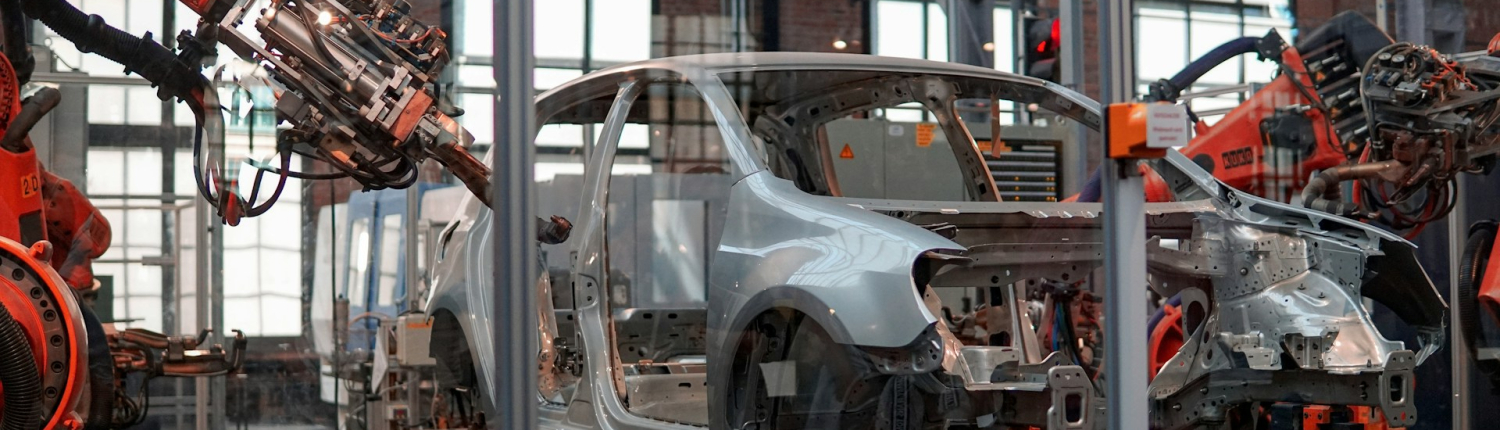
Around a third of every industrial robot working in factories worldwide sits inside a car plant, according to the International Federation of Robotics. Walk the floor of a modern vehicle plant and there is a choreography of robotic arms swinging body panels into place and autonomous mobile robots transferring components between stations.
But where do the robotics engineers and automotive technicians come into this? We’ll look at the current state of robotics in car manufacturing and what it means for the people alongside the robots.
What Do Robotics in Automotive Manufacturing Do?
Automotive robotics covers industrial and collaborative robots and autonomous systems that build, move, join and inspect vehicles and their components.
Eight applications carry most of the work:
• Welding
• Press and stamping
• Paint and sealant
• Assembly and part placement
• Material handling
• Finishing and inspection
• Supply chain
• Packaging and palletizing
The car industry effectively invented automated manufacturing, and it still runs the densest deployments of robots.
What Do Automotive Robotics Look Like Today?
Global factories installed 542,000 industrial robots in 2024, more than double the figure from 10 years earlier, according to the International Federation of Robotics. In the US, car industry installations rose nearly 11% to 13,700 units, and automotive accounted for roughly 40% of all new US robot installations that year.
Density figures show how uneven the picture is. Germany runs 449 robots per 10,000 manufacturing employees and Japan 446, against 307 in the US and a Western European average of 267. Germany’s position reflects decades of automotive investment, and it explains why DACH salaries for robotics engineers sit where they do.
Three forces sit behind this rise in robotics:
1. Electrification backed by regulation
The European Union plans to end sales of new combustion vehicles by 2035, the US has targeted a 50% electric vehicle market share by 2030, and China requires all new vehicles sold from 2035 to run on new energy.
2. Reshoring and supply chain pressure
Tariffs, trade disruption, and the memory of pandemic-era shortages have pushed manufacturers to bring production closer to demand, and robotics makes high-cost locations viable.
3. Labor availability
Japan is deploying robots specifically to offset a shrinking working-age population, filling roles that would otherwise sit vacant. Across the sector, an aging workforce and shortages in skilled production roles have made automation the default answer to capacity constraints.
How Do Car Manufacturers Use Robotics and Automation?
The economics have flipped. Robot costs have fallen while redesigning an assembly line remains expensive, so manufacturers now fit machines into workflows built for people instead of rebuilding the plant around the machine.
This shift explains the interest in humanoids, which are human-shaped robots that slot into a workstation designed for a human. Training has become faster too. By combining simulation-based reinforcement learning with imitation learning, where a robot learns by watching the work done, automakers can cut training times from months to days.
The following car manufacturers are integrating automotive robotics into their operations:
• BMW Began test deployment of two Hexagon Robotics humanoids at its Leipzig plant in 2026, with production work planned from the summer, the first humanoid deployment in European car manufacturing.
• Tesla: The Optimus project aims to reduce labor constraints by handling repetitive and physically demanding tasks in its Gigafactories.
• Mercedes-Benz: Partnered with Apptronik to test humanoid robots in material handling and quality inspection.
• BYD: Reportedly operates with approximately 97% autonomy using AI-powered robotics, digital twin technology and automated guided vehicles (AGVs) in its warehouses.
• Geely: Collaborated with Siasun Robot & Automation for a large-scale expansion of primary welding lines.
• General Motors: Uses exoskeletons for repetitive tasks on Cadillac, Chevrolet, GMC and Buick vehicles.
Every one of these deployments depends on engineers who can integrate and train the machines, and those engineers are getting harder to find.
The Talent Bottleneck Behind Every Automation Program
Demand for robotics and automation engineers is growing 22% year-on-year, the second-fastest rate of the six roles tracked in our Industrial Automation Salary Guide in 2026, and our team rates it Hot on urgency.
That pressure shows up clearly in pay, too:
• In DACH, the automotive sector drives senior robotics salaries into €80,000 to €108,000, with BMW, Volkswagen and Mercedes-Benz among the primary employers.
• Senior controls engineers in the same market reach €82,000 to €110,000, with automotive again the dominant employer.
• Senior robotics engineers in the US command $115,000 to $148,000, and in the UK, the senior range runs £60,000 to £82,000.
• Vision-guided robotics adds a premium above standard ranges: £6,000 to £12,000 in the UK, €8,000 to €14,000 in DACH, and $10,000 to $18,000 in the US. Automotive and medical devices drive that demand hardest.
The shortage is one of skills rather than headcount. Research from the ARM Institute and Deloitte Consulting identifies robotics technicians, automation engineers, machine vision specialists and production data analysts as the profiles in short supply. The same research finds that technical career pathways are advancing faster than the workforce can retrain into them.
Deloitte and the Manufacturing Institute put the US manufacturing gap at as many as 3.8 million roles between 2024 and 2033, with close to 1.9 million at risk of going unfilled.
What This Means If You're Hiring
So, how do you get ahead of the problem? Employers benefit from having a sharper recruitment process and a stronger offer. This translates to attracting better candidates in the first place and then securing them when you find them.
Five things that help automotive employers land stronger robotics candidates include:
1. Specifying the platforms you work with alongside the discipline
2. Benchmarking against live market data
3. Planning separate timelines for UK, DACH and US searches
4. Budgeting for retraining and measuring it
5. Moving swiftly with the potential competition of other offers
Then, salary opens the conversation, but it rarely closes the deal on its own, as we noted in our Additive Manufacturing Salary Survey. Professionals today prioritize the following:
• Focus on flexibility: A lack of remote or hybrid working was the most common reason candidates gave for turning down a role they otherwise wanted (59%).
• Role clarity: More than half of professionals (53%) named unclear responsibilities and success metrics as a reason to decline.
• Balance and leadership: Candidates now weigh workload management quality against the offer, with a narrower view on the day-to-day rather than overarching goals.
The offer and hiring process you have matters just as much as the search for top candidates. In a market this tight, the employers who benchmark honestly and are clear about expectations are the ones who land the engineers everyone else is hoping for.
What This Means If You're A Candidate
The Industry 4.0 market, particularly automation, is becoming more selective, and specialization is what separates the top compensation quartile from the rest. There are three investments which move automation and robotics engineers into the strongest pay bands:
1. Platform breadth: Confidence across collaborative, mobile and legacy systems makes you more deployable on more projects and signals you can integrate on the job instead of relearning from scratch.
2. Machine vision experience: This carries the clearest salary premium in the automation market, and automotive and medical devices drive that demand hardest, so vision-guided work is worth prioritizing.
3. Simulation fluency: Digital twin and reinforcement learning environments now sit at the front of most deployment projects, and engineers who can build and validate in simulation are more likely to be considered for premium roles.
The common thread here is the depth in the skills tied to the business’ live deployment. As hiring plans tighten, employers desire engineers who can show direct impact on quality and uptime.
Explore the full market picture in our Industrial Automation Salary Guide.
Build Your Automotive Robotics Team with Alexander Daniels Global
Here at Alexander Daniels Global, we’re industry experts in global robotics and automation recruitment, with offices in Birmingham, London, Berlin and Detroit. We recruit across the Industry 4.0 sector, including automotive, in the UK, DACH and the US, with a core focus on the hard-to-fill technical roles that require deep sector literacy and an established global network.
If you are scaling an automation program, get in touch with us to see how we can help build the team. If you are weighing up your next move, explore our job board for the latest opportunities.
